November 21, 2026
Why AI tools do not mention your local business—and how to fix it
Learn why AI assistants overlook local businesses and how to improve your service pages, business information and evidence with Ask Hercules.
By Colleen Nagle, Founder of Muse Platforms and Ask Hercules
To improve your chances of appearing in AI search as a local business, make your services, location and qualifications easy to find and verify. Publish useful answers to local buyer questions, keep your business information accurate, remove website access problems and test whether AI assistants actually mention or cite you. No single change guarantees a recommendation.
Imagine a business owner in Queens asking an AI assistant for someone who can rebuild a small company's website and improve its search visibility. Your firm does exactly that. You have relevant experience, satisfied clients and a clear way to get in touch. Yet the answer names three other companies.
That result deserves investigation. It does not establish that those companies are better, or that your business is invisible everywhere. It tells you that, in one response to one question, your business did not make the answer.
At Ask Hercules, we recommend turning that moment into a practical investigation: what did the question require, what evidence did the assistant use, and what information could your business make more useful?
Start with the question a customer would actually ask
Searching for your own company name is an identity check. It does not tell you whether someone who has never heard of you will discover your services.
Write down ten questions from sales conversations, inquiry forms or customer emails. Include the service, location and buying condition that matter. For example:
- Who builds websites for small professional service firms in Queens?
- Which Brooklyn bookkeeping firms work with independent creative businesses?
- Where can I buy a replacement guitar pickup in Manhattan and have it installed?
- What should I ask before hiring a local contractor to renovate a small office?
These are illustrative questions, not evidence of search demand. Replace them with language your customers use. Avoid inserting your brand into every prompt; that makes the test easier while telling you less about discovery.
Run the same questions more than once. Record the platform, date, stated location, answer and source links. If one platform names you and another does not, investigate the difference before rewriting the whole website.
Look for five common information gaps
Your service description is too broad
“We help businesses thrive” does not explain who should hire you. A buyer needs to know what you do, who you serve and where you work. A retrieval system also needs text that relates to the question.
As an illustrative rewrite, replace “Your partner in digital transformation” with “We build WordPress websites for independent consultants and small agencies in New York City.” Use that wording only if it accurately describes the business. Follow it with scope, process and a relevant example.
Your local facts disagree
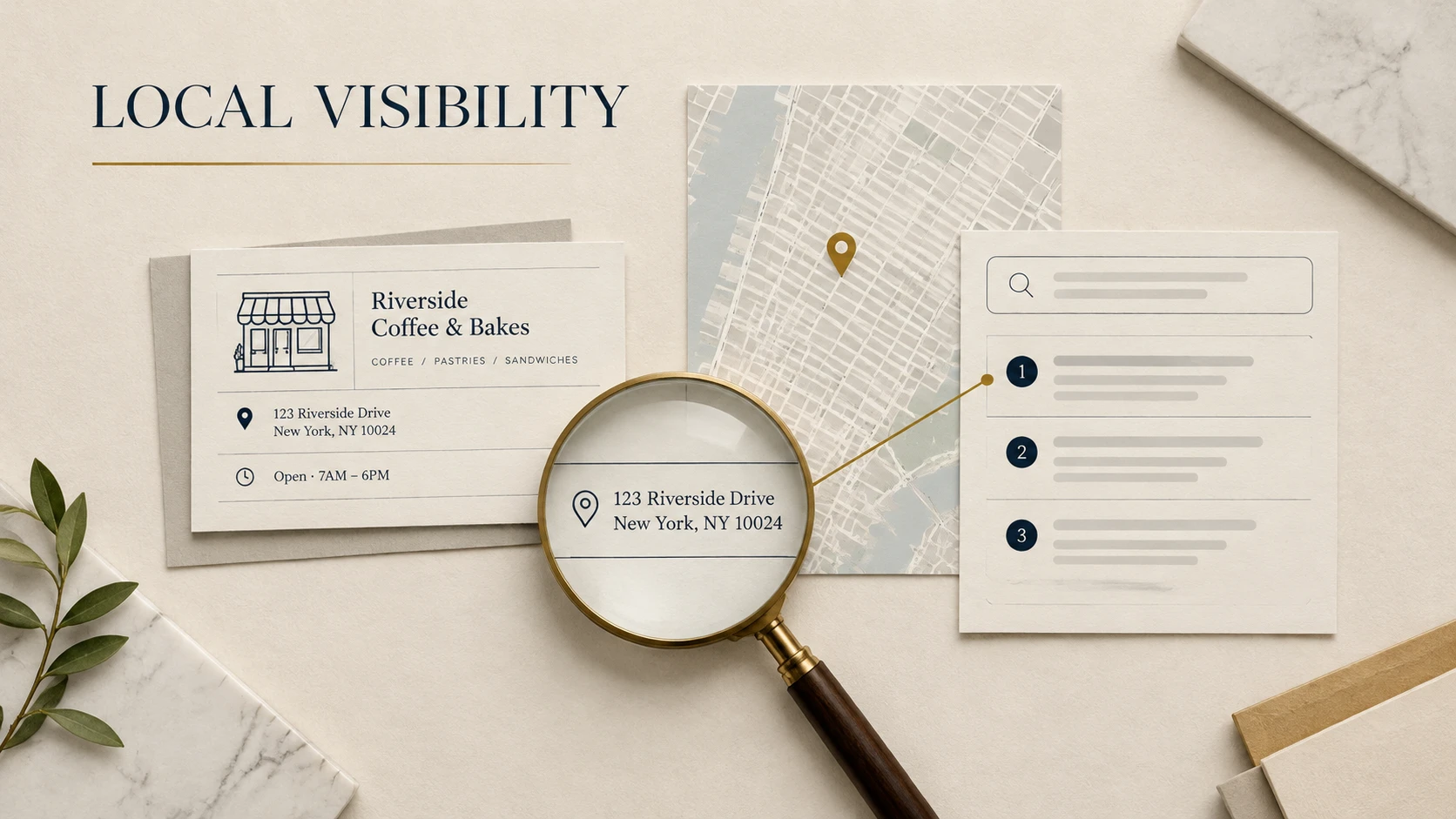
A former address on one profile, an old phone number on another and a different business name on your website create avoidable ambiguity. Make a short inventory of the profiles customers actually encounter and correct material errors.
Google says local ranking is based mainly on relevance, distance and prominence. Its guidance emphasizes complete business information and accurate hours and categories. That guidance concerns Google local results; it is not a published ranking formula for every AI assistant. [1]
For an eligible Google Business Profile, maintain accurate details. For a service-area business, describe the area honestly. Do not invent a storefront or create a location page that implies you have an office where you do not.
Your strongest information is hard to extract
A beautiful image may contain your full service list while the page itself says almost nothing. Important facts may also be hidden behind a login, an interaction or a page that fails to load.
Ask your web team to check whether the core service description is accessible as text, whether the intended public page can be crawled and whether technical directives conflict with the goal of being found. Treat these as diagnostic questions; different crawlers handle websites differently.
The page offers claims without evidence
“The best in New York” gives a reader little to examine. A named qualification, a specific project description or a permissioned customer review gives them something to evaluate.
Describe the problem, what your team did and what the evidence establishes. If a project improved load time, say that. If you have no evidence that it increased sales, leave sales out of the claim.
The website never answers the buying question
A list of services rarely addresses scope, fit, preparation or tradeoffs. Those are often the details that help a customer decide whether to call.
Write answers to questions such as “What is included?”, “What do you need from me?” and “When is this service not the right choice?” Specific boundaries can make your offer easier to understand.
Build one useful local service page
Choose the service you most want to sell. Give it a page that a real prospect could use to make a decision. A practical structure is:
A direct description of the service, audience and actual service area.
The customer problem and the work included in solving it.
A short explanation of how the engagement works.
Relevant qualifications and a documented example.
Answers to common questions, including limitations.
A clear next step, such as requesting an estimate or discussing a project.
For a retailer, add accurate product and availability information where appropriate. For a service firm, clarify scope and how pricing is determined. Do not promise exact stock, turnaround or prices that you cannot maintain.
Google's AI-search guidance says there is no special schema or new AI text file required to appear in AI Overviews or AI Mode. Keep useful content and sound website fundamentals at the center of the work. [2]
Use Ask Hercules to connect diagnosis with action
Ask Hercules organizes the work around Audit, Fix and Track. Its Crawl Readiness Index (CRI™) examines areas such as answerability, served-page visibility, trust readiness, crawl health and topical cohesion. These checks help identify site issues worth investigating; the score itself is not evidence of a recommendation.
The platform also measures responses across ChatGPT, Claude, Gemini and Perplexity and distinguishes grounded citations from mentions. That distinction matters: a name in an answer and a retrieved link to your website provide different kinds of evidence. See the Ask Hercules methodology. [3]
Use an audit finding to choose one change with a clear rationale. If the service area is missing, clarify it. If the page does not answer a buying question, add a useful answer. If the claim lacks evidence, supply support or narrow the claim.
Measure inquiries as well as visibility
Keep a record of changes and retest the same questions under comparable conditions. Review whether the business is named accurately, whether a source links to the right page and whether that page gives a customer a useful next step.
Separately, track qualified calls, forms and booked conversations. Ask new prospects how they found you and record their wording. Someone may discover you in an AI answer and later return by typing your name, so referral analytics will not capture every path.
Our recommendation is to begin with one service page and a small, stable question set. Expand when you understand what changed. A larger content calendar is useful only when it is solving identified gaps.
Frequently asked questions
Can a small business appear alongside larger competitors?
It is possible, but no business has a guaranteed place. Build evidence for a specific service and customer need, then test actual responses. A narrow, useful answer gives you a clearer improvement target than a broad claim to be the best.
Does being missing from one AI answer mean my business is invisible?
No. The result applies to that question and test context. Repeat the question and examine other relevant questions and platforms before drawing a broader conclusion.
Who can help diagnose why AI tools overlook my business?
Look for a provider that can inspect your website, show the exact answers and sources it measured, and implement the improvements it recommends. Ask Hercules provides the software workflow; Muse Platforms can discuss hands-on delivery within an agreed scope.
Find the first gap worth fixing
Explore Ask Hercules to investigate how your business appears in AI answers. If you want help improving the website and content behind those answers, talk to Muse Platforms. Start with the service you want your next customer to find.
Sources
[1] Google Business Profile Help — Tips to improve your local ranking.
[2] Google Search Central — AI features and your website.
[3] Ask Hercules — Methodology.
Ask Hercules is a product of Muse Platforms, Inc.
Want this analysis for your site?
Book a free AI Visibility Review with the Ask Hercules team.
Book your free AI Visibility review