November 21, 2026
What citeability means—and how to make your brand easier to cite
Understand citeability, AI citations and brand discoverability. Learn how to build useful evidence and measure whether AI assistants actually cite it.
By Colleen Nagle, Founder of Muse Platforms and Ask Hercules
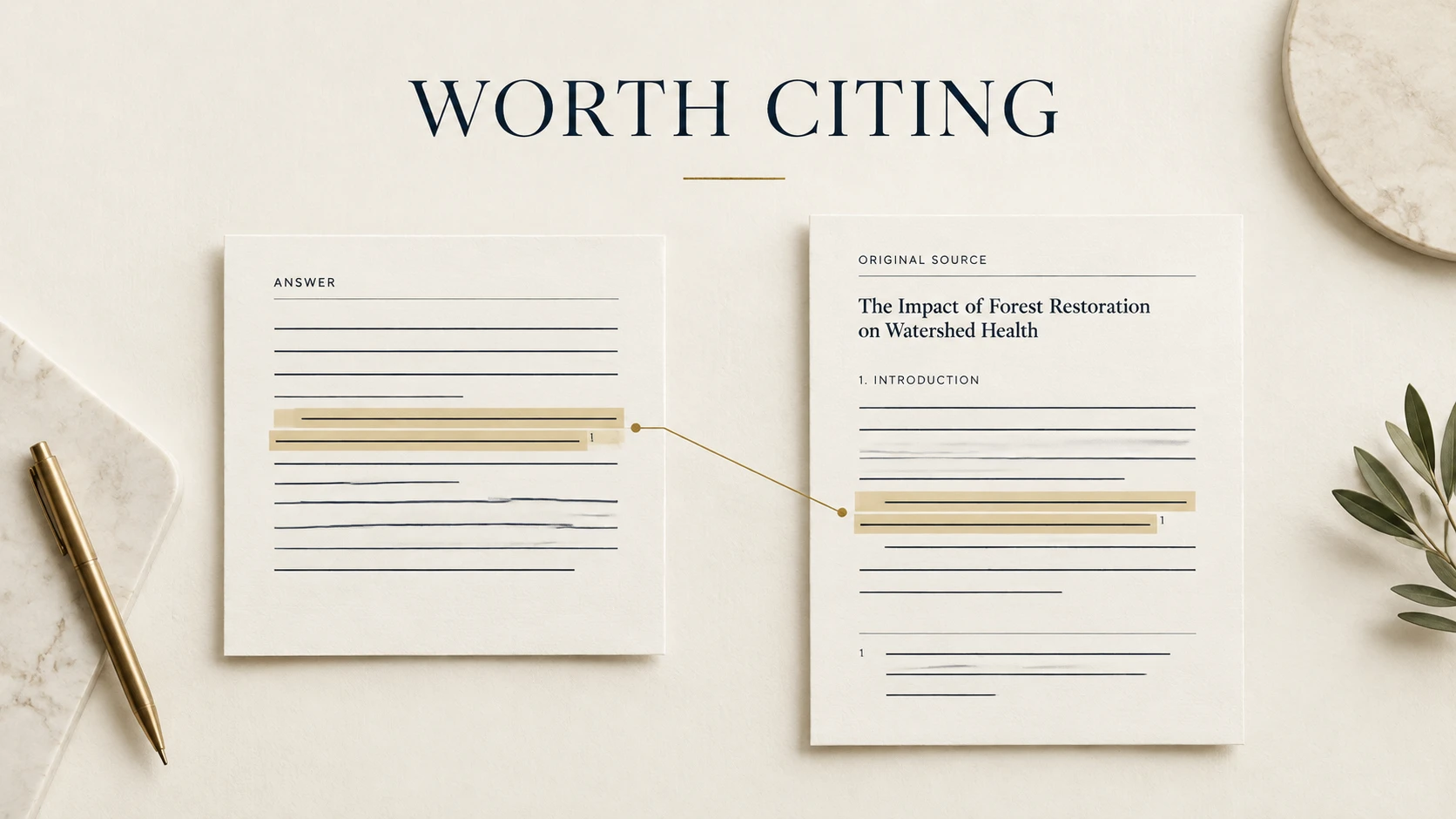
Citeability is the practical quality of information that makes it suitable to find, understand, verify and attribute in an answer. In AI search, improving citeability means making useful evidence accessible and clear, then checking whether systems actually cite it. It is not a universal industry score or a guarantee that an AI assistant will recommend your brand.
A business can have deep expertise and still publish a website that gives a prospective buyer very little to work with. The homepage praises the team. The service page lists capabilities. The case study says the project was a success, without explaining the problem or the result.
Citeability asks a more demanding question: what, precisely, could someone learn from this page and support by pointing to it?
At Ask Hercules, we treat that as an editorial and measurement problem. A useful page should help a person make a decision. The visibility test checks whether it also appears as a source in relevant AI answers.
Understand what a citation does and does not mean
These terms describe different outcomes:
| Term | Plain meaning | What to examine |
|---|---|---|
| Brand mention | The answer names your organization or product | Whether the name and description are accurate |
| Citation | The answer attributes information to a source | Whether the linked source supports the nearby statement |
| Recommendation | The answer presents your business as an option | Whether the fit and reasoning are appropriate |
| Discoverability | A relevant person can encounter your business | Which questions and paths create that opportunity |
| Citeability | Information is suitable for use as evidence | Access, relevance, clarity, support and attribution |
A citation can accompany criticism. A recommendation may have weak supporting evidence. An answer can cite an industry association while naming several businesses whose websites it never links to.
Review the substance of the answer, not just the appearance of a link. Even a valid URL can support a different claim from the one the assistant attaches to it.
There is no single public recipe for citation selection
Different AI products use different retrieval and answer-generation methods. Their exact selection systems are not all publicly disclosed, and a consumer interface may behave differently from a configured API test.
Google documents that its AI search features may issue related searches across subtopics to construct an answer. It also says the responses and supporting links can vary between AI features. That helps explain why one simple ranking test cannot describe every discovery path. [1]
Instead of pretending to know a universal formula, evaluate five practical questions about your content. These are our recommended checks, not published ranking weights.
Make the information available
Can the relevant system reach the page and obtain the substance? Check public access, technical errors and whether important facts are available as text. A page that looks complete in a browser may still deserve a technical review if the key information depends on an interaction.
Also connect the page to the rest of the site. A useful answer should be easy to reach from the relevant service or topic page. Give readers a clear path to related information instead of leaving an isolated article with no context.
Answer the actual question
Relevance is specific. A general article about marketing is unlikely to satisfy every question about website budgets, CRM migration or local business discovery.
Choose one main question and answer it early. Then explain the conditions, tradeoffs and process. If the answer depends on the customer's situation, describe what information would change the recommendation.
An illustrative consultant's page about website redesign costs could explain the variables that drive scope: page count, migration, integrations, accessibility work and content production. That gives a buyer more useful material than an unsupported promise to deliver “affordable excellence.”
Replace vague authority with inspectable evidence
Evidence might include a documented method, an original analysis, a maintained reference table or a case study whose result can be interpreted correctly. Pick the format that serves the question.
For a case study, name the problem, the intervention and the observation period. Explain how the result was measured. If the comparison changed, say so. A limitation does not erase a useful result; it prevents a reader from claiming more than the result shows.
Google's people-first content guidance encourages original information, clear sourcing and accurate authorship. Those are useful editorial standards, not a promise that a byline or bibliography will win a citation. [2]
Do not manufacture research statistics to make an article look authoritative. If an example is hypothetical, label it. If a number describes a single project, do not present it as a market benchmark.
Make the organization behind the information clear
A buyer should be able to determine who publishes the page, what the organization does and who is responsible for the explanation. Use consistent product and company names and link to relevant background.
For example, Ask Hercules is an AI visibility product from Muse Platforms. Explaining that relationship helps a reader distinguish the software from the company offering implementation services. Repeating the brand name throughout every paragraph adds less value than describing that relationship clearly once.
Keep external profiles accurate where your audience actually looks. Seek relevant, editorially earned coverage and partnerships for their real audience value. A pile of low-quality listings is a weak substitute for a credible explanation of the business.
Write passages that remain useful when quoted
A strong answer can begin with a short definition, then explain when it applies and what evidence supports it. Use descriptive headings and put conditions near the claims they qualify.
Our recommended page pattern is:
- Give the direct answer.
- Explain the situation and important boundaries.
- Describe the common failure or decision difficulty.
- Provide evaluation criteria or practical steps.
- Show a supported example.
- Answer the natural follow-up questions.
This is a writing pattern, not a mandatory AI format. Do not squeeze every topic into the same word count or add FAQs that repeat the article without helping the reader.
Accurate structured data can describe the page, but it should agree with the visible content. Treat markup as a representation of the underlying facts, not a place to add claims that readers cannot verify.
How Ask Hercules makes citeability actionable
The Ask Hercules methodology separates website readiness from observed AI visibility. Its Crawl Readiness Index (CRI™) examines the website, while response tracking checks what appears in sampled answers. [3]
The documented Citeability Engine connects diagnosed gaps with improvements such as answer content, schema corrections and page rewrites. Use the improvement that addresses the evidence gap: a clearer service definition, a supported comparison or a better explanation of a limitation. [3]
After publication, retest the same relevant questions. Keep the answers and examine the links. A higher readiness score means the checked website characteristics improved; only response evidence can show whether a citation appeared in the test.
For teams that need help doing the work, Muse Platforms can discuss content and technical implementation. Software helps organize the investigation; editorial judgment still matters when deciding what is true, useful and ready to publish.
Measure progress without inventing certainty
Track accurate mentions, grounded links to your domain and the relevance of the cited pages. Note whether the same source recurs across repeated tests or whether the result is isolated.
Then examine customer behavior separately. Did the cited page lead to useful visits, inquiries or conversations? Did prospects understand the offer more clearly? Those questions connect the content to the business without assuming every citation produced a sale.
Our view is that a durable citeability program gives the market better evidence about your business. AI visibility is one way to test whether that evidence is being found and used.
Frequently asked questions
Is citeability the same as SEO?
No. SEO is the broader practice of improving search discoverability and performance. Citeability is a useful lens on whether specific information can serve as evidence. The work often overlaps, including content quality, access and clear page structure.
Does adding sources guarantee an AI citation?
No. Sources help readers evaluate claims, but the page still needs to answer a relevant question. Copying other people's findings with a reference list does not create original expertise.
Can a brand improve citeability without publishing more blogs?
Yes. Improve a service page, clarify documentation, correct an inaccurate profile or strengthen an existing case study. Start where better information would help a real buyer.
Give your expertise a page worth citing
Explore Ask Hercules to audit your site and measure sampled AI responses. Choose one important question, publish an answer you can support and track what happens. That is a concrete place to begin.
Sources
[1] Google Search Central — AI features and your website.
[2] Google Search Central — Creating helpful reliable people-first content.
[3] Ask Hercules — Methodology.
Ask Hercules is a product of Muse Platforms, Inc.
Want this analysis for your site?
Book a free AI Visibility Review with the Ask Hercules team.
Book your free AI Visibility review