November 21, 2026
AEO for regulated industries: the path to responsible AI visibility
Build an AEO workflow for regulated content with supported claims, human review and clear measurement. Learn what to ask about SOC 2 and forecasts.
By Colleen Nagle, Founder of Muse Platforms and Ask Hercules
AEO for regulated industries means making approved, substantiated information easier for answer engines to find and interpret while preserving the organization's review controls. The practical approach is to define permitted claims, support them with evidence, keep qualifications beside the claims and measure published results. An AI visibility score does not establish legal compliance.
A healthcare organization, financial firm or legal practice may have expertise worth discovering and little room for careless wording. A short answer can become misleading if it loses the condition that makes it true. A useful service description can turn into an unsupported promise when a writer tries to make it more persuasive.
Our view at Ask Hercules is that precision belongs inside the content process from the beginning. The aim is to make the approved explanation easier to understand without expanding what it claims.
The workflow below is an editorial and operational recommendation. Your legal, compliance and security reviewers determine the requirements for your organization, audience and jurisdiction.
Separate content review from software assurance
Two questions often become tangled together: whether the software is appropriate for your data, and whether the published content is appropriate for your audience.
A content review examines statements, evidence, qualifications and context. A vendor review examines the service and its handling of information. Passing one review does not settle the other.
For US advertising, the FTC's substantiation policy requires a reasonable basis for objective claims before they are distributed. That is a useful reason to collect support before writing a stronger headline. Sector-specific and jurisdiction-specific requirements still need their own review. [1]
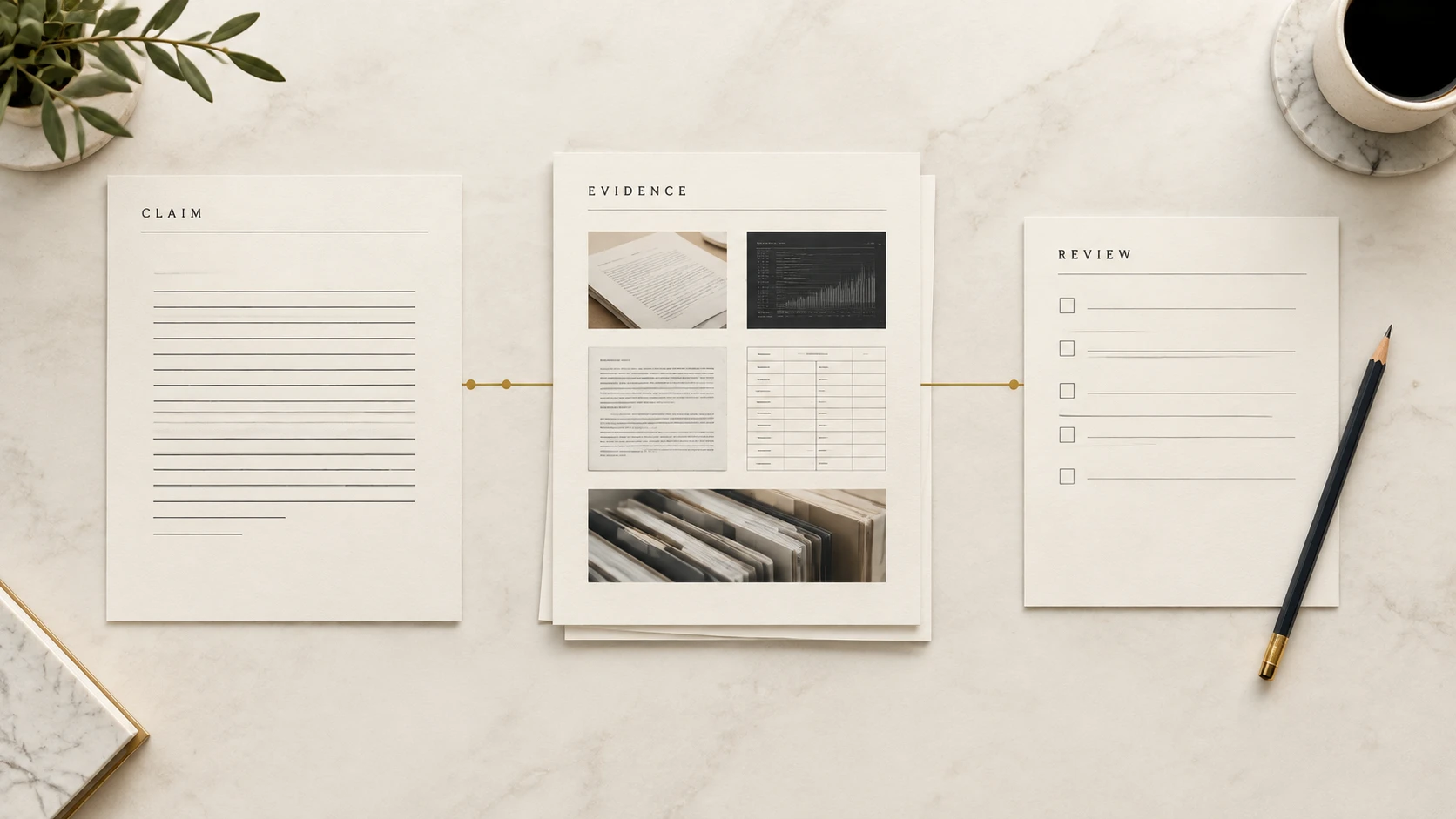
Create a claim record with the exact proposed statement, the evidence behind it, relevant limitations, an owner and a review date. This can live in your existing approval system. Do not assume an AEO platform replaces that system.
Start with approved public information
Choose a narrowly defined question that your organization is authorized to answer publicly. An explanation of how to prepare for a first consultation is often a more manageable starting point than a claim about the results a particular person will receive.
For each page, distinguish general information from individualized advice. Identify the audience, the service and any relevant geographic scope. Link to the appropriate next step when the reader needs an assessment that the page cannot provide.
As an illustrative example, a legal practice might explain what information a prospective client can gather before discussing a trademark matter. It should not turn that preparation guide into a promise of registration or legal success. The responsible subject-matter reviewer determines the final wording.
Keep the qualification attached to the answer
Useful short answers can still carry boundaries. Draft the answer so that the most important condition appears in the same paragraph as the claim it limits.
For example, a service description might say that a firm supports a defined type of organization in specified jurisdictions, with availability subject to an initial assessment. That helps readers understand the offer without implying universal eligibility.
Review headings, tables, captions and structured data as well as body copy. A cautious paragraph does not fix an overbroad headline. If one passage is extracted on its own, it should remain as accurate as reasonably possible. You cannot force an AI system to preserve every qualification, which makes post-publication monitoring valuable.
Build an approval workflow people can follow
We recommend six steps for each substantive content change:
- Define the question, audience and intended page.
- Identify the approved source material and permitted claims.
- Draft the answer and document the proposed changes.
- Route the draft to the responsible subject-matter and compliance reviewers.
- Publish the approved version and retain a dated record of it.
- Recheck the live page and relevant AI answers for inaccuracies or missing qualifications.
Keep revision history, reviewer decisions and rollback information in a system approved by your organization. Set review triggers for material changes to services, evidence or rules. Avoid putting sensitive client or patient information into research prompts simply to make an example feel realistic.
These steps are a proposed operating process, not a claim that every AEO product provides enterprise approval routing, immutable records or sector-specific controls.
What to ask when searching for SOC 2 compliant AEO software
Treat “SOC 2 compliant” as the beginning of a vendor conversation. AICPA describes SOC services as CPA assurance reporting on organizational or service-system controls. The report's scope and findings matter more than a badge on a landing page. [2]
Ask the vendor which legal entity and service the report covers, what period or date it addresses, and how you can review the applicable report. For a Type II report, ask about the examination period, exceptions and the controls your own organization must operate. Have your security team interpret the evidence. [3]
Also ask practical questions about the proposed use:
What information will be sent to model providers or other subprocessors?
How are retention, deletion and access handled?
Can the project operate using public website content only?
What contractual terms and supporting documentation are available?
Which required controls belong to the vendor, and which belong to us?
Do not infer Ask Hercules' SOC 2 status from this article or from its AEO capabilities. Confirm current assurance evidence directly before procurement. A vendor assurance report also does not certify that a particular marketing claim is lawful.
Can a tool predict impact before compliance approval
A tool can help estimate whether a proposed edit addresses a diagnosed problem. It can compare clarity, completeness, factual support and technical accessibility. Those are useful pre-publication signals.
They are not a reliable promise of a future citation rate. A test that supplies the draft directly to a model measures the model's response to supplied text. It does not reproduce whether a public assistant will discover, select and cite the published page later.
For a proposed edit, prepare a short decision note: the observed gap, the change, the evidence supporting it, the expected mechanism and the measurement plan. Label expected effects as hypotheses. Avoid attaching a precise revenue or citation forecast unless you have a defensible method and have disclosed its limitations.
For example: “The approved page omits the service's geographic scope. We propose adding that scope to the opening answer, then monitoring whether location-related answers describe the service correctly.” That is a testable rationale a reviewer can assess.
Where Ask Hercules fits
Ask Hercules supports investigation of website readiness and sampled AI visibility. Its documented approach distinguishes grounded citations from brand mentions and retains response evidence for review. Those capabilities help a team identify an issue and examine whether later responses change. [4]
Use that evidence within your existing governance process. A content improvement can address readability or missing context while your reviewers retain authority over what is published. For implementation support, Muse Platforms can discuss an engagement with explicit responsibilities and approval boundaries.
Our recommendation is a small pilot using approved public pages. Evaluate the quality of the evidence, the review workload and the accuracy of the resulting answers before expanding the scope.
Frequently asked questions
Does better citeability make a claim compliant?
No. Citeability concerns how readily material can be found, understood and attributed. Whether a claim is permitted depends on its substance, evidence, context and applicable requirements.
Can we improve AEO without publishing new claims?
Yes. You can clarify existing approved explanations, correct outdated factual details, improve page access and make supporting sources easier to follow. Material changes should still pass through the review process your organization requires.
Should we publish a draft so an AI tool can test it?
Do not bypass approval to obtain a measurement. Use an approved private review environment for draft assessment, recognizing that the result does not prove public discoverability. Test live visibility after authorized publication.
Make the next improvement reviewable
Talk to Muse Platforms about a scoped AI visibility assessment, or explore the Ask Hercules methodology. Bring one approved page and one question your audience needs answered. That creates a concrete starting point for both the content team and its reviewers.
Sources
[1] Federal Trade Commission — Policy Statement Regarding Advertising Substantiation.
[2] AICPA and CIMA — System and Organization Controls suite of services.
[3] AICPA — SOC 2 Report Review checklist.
[4] Ask Hercules — Methodology.
Ask Hercules is a product of Muse Platforms, Inc.
Want this analysis for your site?
Book a free AI Visibility Review with the Ask Hercules team.
Book your free AI Visibility review